How a Canadian wellness brand ranked #1-#5 across 8 locations.
Our client operates in one of Canada's most competitive and regulated wellness niches, with multiple retail locations across the Prairie Provinces and an ecommerce arm serving customers nationally. We blended local SEO, ecommerce optimization, and a compliance-aware playbook to drive significant ranking gains across every single location.
- Wellness
- SEO
- Multi-Location
- +312%Organic Traffic Growth
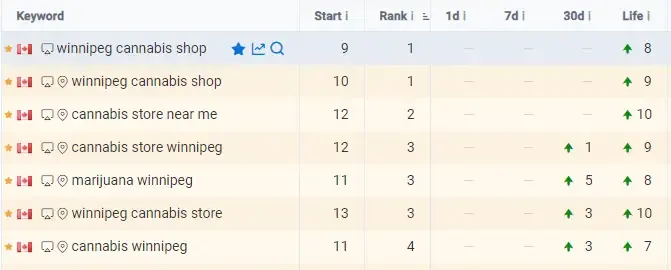
- #1-#5Across Competitive Local Keywords
- 8Locations Ranking Top of SERPs
- 13 → 90+Core Web Vitals Score Lift
Wellness & Lifestyle Brand — Canada
- IndustryWellness & lifestyle retail (regulated category)
- FootprintPrairie Provinces — Manitoba, Saskatchewan, Alberta
- ChannelsEcommerce + 8 brick-and-mortar locations
- EngagementTechnical SEO · Local SEO · Ecommerce SEO · GBP
A regulated wellness brand with multi-location ambitions.
Our client operates a wellness and lifestyle brand with retail locations throughout the Prairie Provinces of Canada, plus an ecommerce arm serving customers nationally. The niche is highly competitive, compliance-sensitive, and limited in the marketing channels it can legally use — which makes SEO the most important growth lever available.
Customers buy both online and in-store, which means the SEO strategy has to do two things at once: rank for hyper-local 'near me' queries that drive walk-in traffic to specific stores, AND rank for broader ecommerce queries that drive online orders nationally.
Before partnering with Hexapoint, the brand had strong product-market fit but very little organic visibility, a technically broken website, and no playbook for handling the regulatory constraints that block most of the standard local-SEO tactics.
Four obstacles we had to solve together.
- i.
Multiple Locations, Zero Cannibalization
A multi-location SEO strategy has to do several things at once without trading one win for another loss.
- Manage and differentiate a dozen+ Google Business Profiles.
- Promote physical traffic to each location without cannibalizing keywords between cities.
- Rank for broad regional terms AND hyper-local long-tail queries.
- Balance ecommerce keywords against brick-and-mortar visit intent.
- ii.
A Highly Competitive Niche
In the client's biggest market there were more competitors than there are Tim Hortons. Location-specific keywords with high commercial intent had brutal difficulty scores.
- Top-converting local keywords were saturated with established competitors.
- Ranking required a heavy investment in original, authoritative content.
- Backlink profiles needed to be aggressively built across every location.
- Technical optimization had to be near-perfect to be competitive at all.
- iii.
Marketing Restrictions
Google does not allow Google Business Profile posts in this client's category — and GBP is essential to local SEO. We had to redesign the entire local-SEO playbook around the GBP tactics that are permitted.
- No GBP Posts allowed in the category.
- No paid search on the most obvious commercial keywords.
- Strict creative restrictions on what claims, words, and imagery can be used.
- Compliance review required on every piece of public content.
- iv.
Poor Technical Optimization
The site had hundreds of product pages with the typical ecommerce problems, compounded. Before any content or keyword work could pay off, the site had to actually be usable.
- Oversized, unoptimized images everywhere.
- Schema either missing or broken across product and location pages.
- Widespread 4XX errors and orphan pages.
- A Core Web Vitals score of just 13 out of 100 on mobile.
The fixes, in order of impact.
A regulated, multi-location, ecommerce-plus-brick-and-mortar SEO program demands sequencing. We fixed the foundation, then layered keyword strategy, content, schema, and GBP — each step compounding on the last.
- 01
Address The Technical Issues First
You can build perfect content with perfect keyword targeting, but if the site is unusable nothing else matters. Our team led with the technical fundamentals so every later layer would compound.
- Optimized images (modern formats, correct sizing, alt text, lazy loading).
- Minified CSS and JS, removed unused code and render-blocking resources.
- Eliminated layout-shift contributors and improved LCP for every template.
- Lifted Core Web Vitals from 13 to a sustained 90+ across mobile and desktop.
- 02
Target The Right Keyword Mix
We prioritized hyper-local commercial and transactional keywords with high conversion potential, alongside a long-tail content strategy. Each location was mapped to its own keyword universe to prevent cannibalization while keeping city and province coverage intact.
- Generic product keywords for ecommerce intent.
- Hyper-local entities — neighborhood and district-level queries.
- Generic local terms at the city and province level.
- Long-tail informational queries that feed branded conversions later.
- 03
Build Location Pages And Location Hubs
Hyper-local location pages rank for "near me" queries without stealing equity from the broader city-level hub pages. The hubs rank for broad regional queries and pass authority down to the hyper-local pages through carefully managed internal linking.
- Hyper-local pages targeted neighborhood + district queries with unique on-page content.
- City and province hub pages targeted generic local searches.
- Internal links flowed authority from hubs down to hyper-local pages — never the reverse.
- Cannibalization avoided by careful keyword scoping per page.
- 04
Optimize High-Impression Product Pages
Ecommerce pages with strong impressions but poor click-through were our highest-ROI targets. We rewrote, restructured, and re-positioned them to actually convert the traffic they were already attracting.
- Updated content to compete for featured snippets and rich results.
- Rewrote meta titles and descriptions for click-through, not just keyword stuffing.
- Surfaced CTAs above the fold and tightened conversion paths.
- Built FAQ schema and product schema on every high-impression page.
- 05
Add Product And LocalBusiness Schema
We standardized Product schema (including aggregateRating) on every product page and LocalBusiness schema on every location page. The visible result was richer search appearances; the structural result was a clear edge over competitors that had not invested in schema.
- Product schema with aggregateRating on every product page.
- LocalBusiness schema on every location page.
- BreadcrumbList schema across the site.
- FAQ schema on FAQ-heavy content pages.
- 06
Optimize Google Business Profiles Without GBP Posts
With over a dozen physical locations and no permission to make GBP posts, we leaned on the tactics that were still permitted. The result was 3-pack rankings on the most competitive "near me" query in the entire category.
- High-quality, consistent NAP citations across the local web.
- Unique descriptions and product/service entries per individual GBP.
- Direct GBP-to-location-page linking for every store.
- Ongoing review-generation work tied to verified customer interactions.
Rankings tracked weekly across target service areas. Organic traffic measured against the same year-over-year periods. Core Web Vitals reported from anonymized field data, not lab tests. All keyword-level results pulled from search-console data — no platform self-reports.
The numbers
- +312%Organic Traffic — YoY
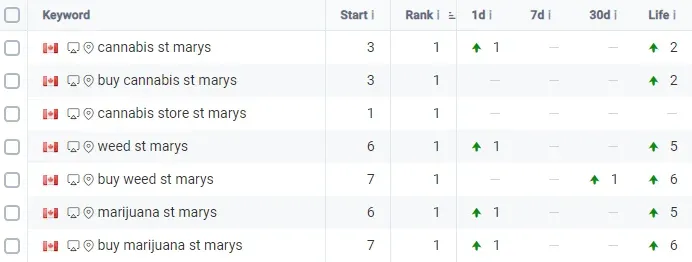
- #1-#5Across Competitive Local Keywords
- 8Locations Ranking In 3-Pack
- 13 → 90+Core Web Vitals Score
Direct challenge resolution.
- ✕
Previous Challenges
Where the brand stood before engaging Hexapoint.
- Not ranking for high-converting commercial keywords in any city.
- No 3-pack presence on any "near me" queries.
- Site failing Core Web Vitals (mobile score: 13).
- No schema, broken meta, orphan product pages everywhere.
- ✓
Achieved Outcomes
After sustained execution across all 6 strategy pillars.
- Top-5 organic rankings on the most competitive commercial keywords.
- 3-pack presence on the highest-volume "near me" query in the category.
- Core Web Vitals sustained 90+ across mobile and desktop.
- Standardized schema, meta, and templates across every product and location page.
Lessons for any multi-location retail brand.
There's no one-size-fits-all SEO. The right strategy depends on your industry, competition, location mix, and what's legally available to you. The principles below apply broadly — the specifics need to be tuned to your reality.
- 01
Technical First, Always
Content and keyword work compound on top of a fast, crawlable, technically sound foundation. Skipping the technical layer guarantees the work above it underperforms.
- 02
Hubs + Hyper-Local
Multi-location SEO works when broad regional hub pages pass authority down to hyper-local pages — and never the reverse. The structural discipline matters more than the volume of pages.
- 03
Constraints Reframe The Playbook
When a regulated niche removes your favorite tactics, the work becomes finding the highest-leverage permitted tactics — not lamenting the missing ones. Discipline beats nostalgia.
- 04
Schema Is A Quiet Edge
Most competitors do not invest in clean, complete, schema-rich pages. The brands that do quietly accumulate richer search appearances and stronger CTRs, every month.
What drove these results
Technical SEO Audit & Implementation · Multi-Location Local SEO · Ecommerce SEO · Google Business Profile Optimization · Citation & Local Listing Management · Product & LocalBusiness Schema · Content Hub Architecture · Compliance-Aware Content Strategy.
Every service above sequenced on top of the one before it. Doing them in the wrong order would have wasted months. The compounding came from the order, not from any single tactic.
Multi-location SEO, answered honestly.
How long does multi-location SEO take to drive measurable results?
Technical fixes start moving Core Web Vitals and crawl health within the first month. Local SEO and content gains typically appear in months 2-3, with the largest organic compounding happening across months 6-12. Multi-location work specifically requires patience: each location needs its own dedicated content, GBP work, and citation profile, and those don't all ramp at the same pace.
Can you do SEO for businesses in regulated or compliance-sensitive categories?
Yes. Working inside legally regulated categories is one of the things we do well — including categories where standard tactics like GBP Posts, paid search, or specific keyword variants are not allowed. The work becomes about finding the highest-leverage permitted tactics and executing them better than the competition.
Will hyper-local location pages cannibalize my city-level pages?
Only if they are scoped wrong. Done right, hub-and-spoke structure means city pages rank for broad regional queries while hyper-local pages rank for neighborhood-level queries — and internal linking flows authority from hub down to spoke, never the reverse. We police this with careful keyword mapping per page.
How important is schema for an ecommerce + multi-location business?
Critical, and underused by most competitors. Product schema (with aggregateRating) makes product pages eligible for richer search appearances. LocalBusiness schema on location pages makes them eligible for richer local results. The compounding edge is real — and most of your competition is leaving it on the table.
What if Google doesn't allow GBP Posts in my category?
We work around it. The permitted tactics — high-quality NAP citations, unique GBP descriptions, location-page-to-GBP linking, review generation tied to real customer interactions — are enough to drive 3-pack rankings if executed at scale and with discipline.
Multi-location retail brand ready to grow?
Book a strategy call. We'll show you which keywords your business should be targeting and how to win them — even in regulated, competitive niches.