A crystal-clear return on investment.
Two specialty medical practices in the Northeast US — an orthopedic upper-extremity group and a spine practice — came to Hexapoint with the same problem: their highest-value keywords were either not indexed or ranking on page 5 or 6 of Google. Through patient-targeted SEO and a disciplined Google Ads program, we delivered hundreds of top-3 organic rankings and a 2,602% return on every ad dollar.
- Medical
- Google Ads
- SEO
- Orthopedics
- Spine
- 200+Top-3 Organic Rankings — Orthopedic Group
- 30+Top-Rank Keywords — Spine Practice
- 2,602%Return on Ad Spend (Spine)
- $222Cost Per Surgical Booking (Spine)
Two Specialty Practices, Northeast US
- Client 1Orthopedic group — Upper Extremity Specialists
- Client 2Spine practice — Surgical & non-surgical care
- Service AreaNortheast US (NJ-focused queries)
- ScopeSEO · Website Development · Practice Positioning · Google Ads
Two practices with the same invisible problem.
Both clients came to Hexapoint with strong clinical reputations but flat new-patient acquisition pipelines. Their websites existed and looked reasonable, but the keywords that actually produce surgical revenue — 'elbow doctor NJ,' 'shoulder pain doctor NJ,' 'back doctor NJ,' 'orthopedic surgeon NJ' — were either unindexed on Google or stuck on the fifth or sixth page of results. The traffic that should have been arriving at the clinic was arriving at competitors instead.
The orthopedic group specializes in upper-extremity care. The spine practice runs both surgical and non-surgical programs. Both needed the same thing: patient-targeted SEO that ranked them for the specific commercial queries their ideal surgical candidates were running — plus, for the spine practice, a Google Ads program that could fill the funnel while the organic work compounded.
Hexapoint's brief on both engagements was simple: win rankings on the queries that produce booked appointments and surgical revenue, and prove the ROI down to the procedure.
Three obstacles shared by both practices.
- i.
Invisible On High-Intent Queries
Both practices had clinical depth but no organic presence on the queries that matter for surgical-grade revenue.
- Critical specialty keywords either unindexed or ranking on page 5-6.
- No first-page presence for commercial 'specialty + region' queries.
- Branded query volume thin compared to established competitors.
- No featured snippets earned on condition or treatment content.
- ii.
Undifferentiated Practice Positioning
Both practices read like every other practice on their respective sites. Without practice positioning, even well-ranked pages would underperform on conversion.
- Generic copy that did not reflect the specialty's clinical depth.
- No clear positioning vs. larger regional and hospital-system competitors.
- Surgeon credentials and case mix not surfaced where patients evaluate them.
- No conversion path tuned for high-consideration surgical decisions.
- iii.
No Attribution Down To Surgical Revenue
Both practices had marketing spend going out and assumptions coming back. Without attribution down to the procedure level, there was no way to defend or scale any individual channel.
- No view of which queries actually produced booked surgical consults.
- No cost-per-surgical-booking number to govern paid budget.
- No way to tie Google Ads clicks to attended appointments.
- Budget allocation based on impressions and clicks, not on revenue.
Patient-targeted SEO, plus ads that close.
We ran the same playbook on both engagements with specialty-specific tuning. Patient-targeted SEO produced the compounding asset. Google Ads on the spine practice produced the immediate-flow program that operated against verified surgical bookings — not against clicks.
- 01
Patient-Targeted Keyword Strategy
We mapped the highest-intent surgical and consult-driving keywords for each specialty, then built dedicated content and landing pages for each. No spray-and-pray — every keyword was tied to a specific patient acquisition goal.
- Specialty + geo combinations ("elbow doctor NJ," "back doctor NJ").
- Condition-stage queries that earn trust before commercial intent kicks in.
- Reverse-engineered competitor keyword profiles and targeted their wins.
- Hyper-local long-tail variants captured alongside broader regional terms.
- 02
Website Development
Both practices needed real custom development — not just copywriting changes. We rebuilt around speed, mobile UX, and conversion paths tuned for the way surgical patients actually evaluate a practice before booking.
- Custom-coded templates tuned for Core Web Vitals.
- Surgeon bios, case mix, and credential walls surfaced where patients evaluate.
- Procedure pages structured to win featured snippets and rich results.
- Mobile-first conversion flows for booking and consult requests.
- 03
Practice Positioning & Differentiation
Generic 'we treat patients with X' copy will never convert against well-positioned competitors. Both practices needed sharper, more honest, more specialty-specific positioning that reflected the clinical depth of what they actually do.
- Positioning audits comparing copy and credentials against direct local competitors.
- Clinical-depth narratives developed for each specialty service line.
- Differentiation messaging woven through every primary template.
- Conversion-tuned proof: outcomes, credentials, and case-mix surfaced consistently.
- 04
Google Ads — Spine Practice
For the spine practice, we ran a Google Ads program tuned to surgical intent and operating against the actual cost-per-surgical-booking — not against the clicks the ad platform optimizes by default.
- High-intent spine keyword targeting with strict negative-keyword discipline.
- Landing pages built for consult-deposit conversion.
- Bid strategy optimized against attended appointment volume.
- Reporting framed against $-per-surgical-booking, not $-per-click.
Organic rankings tracked weekly across target service areas. Top-position counts taken from rank-tracking sources, not platform self-reports. Google Ads performance pulled from the ad account directly. Surgical-booking attribution measured against attended consults tied to ad-source clicks via call tracking and form attribution — averaged over a six-month window.
The organic numbers
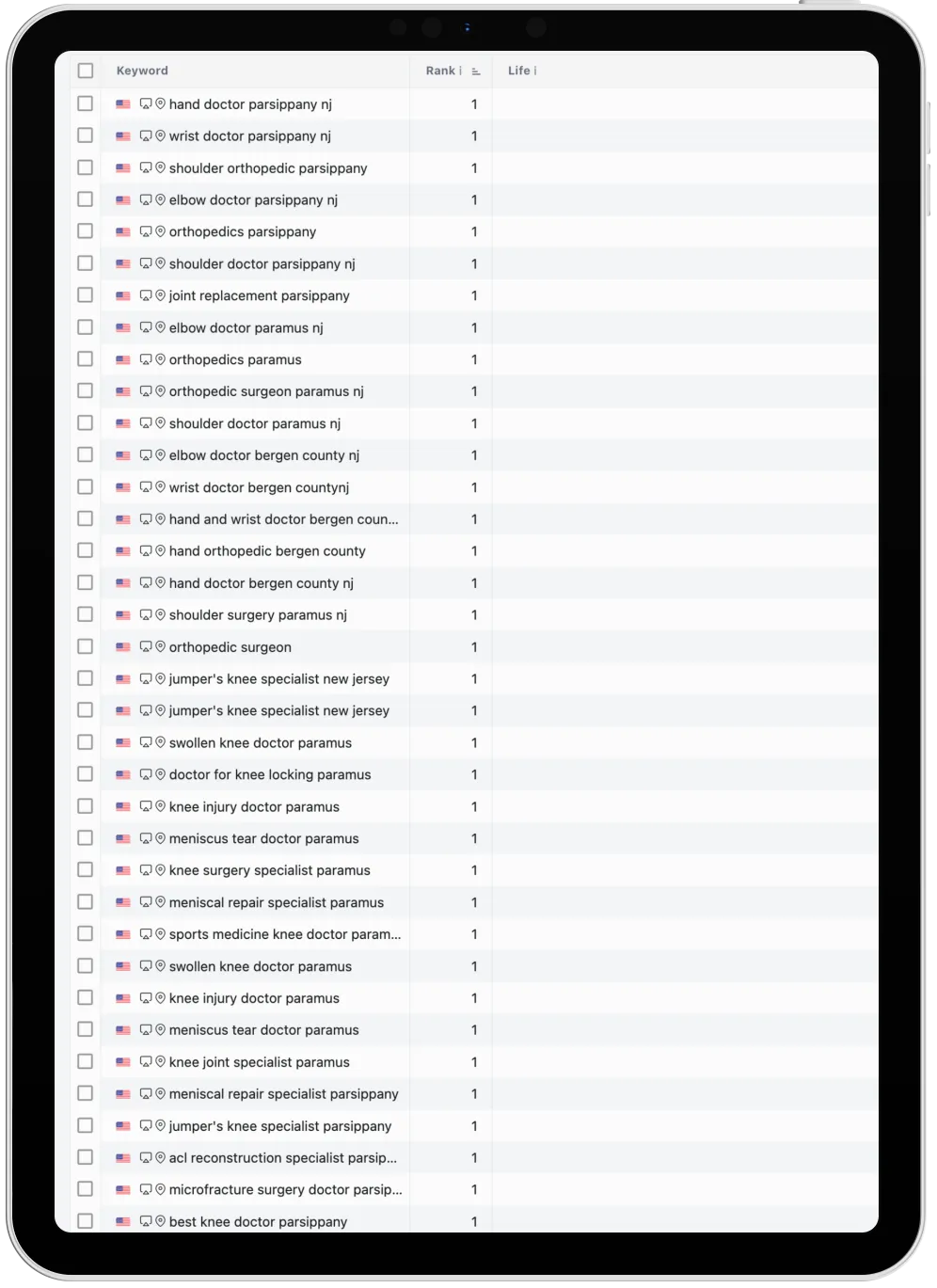
- 200+Top-3 Rankings — Orthopedic Group
- 50+Keywords At #1 (Orthopedic)
- 30+Top 1-8 Rankings — Spine Practice
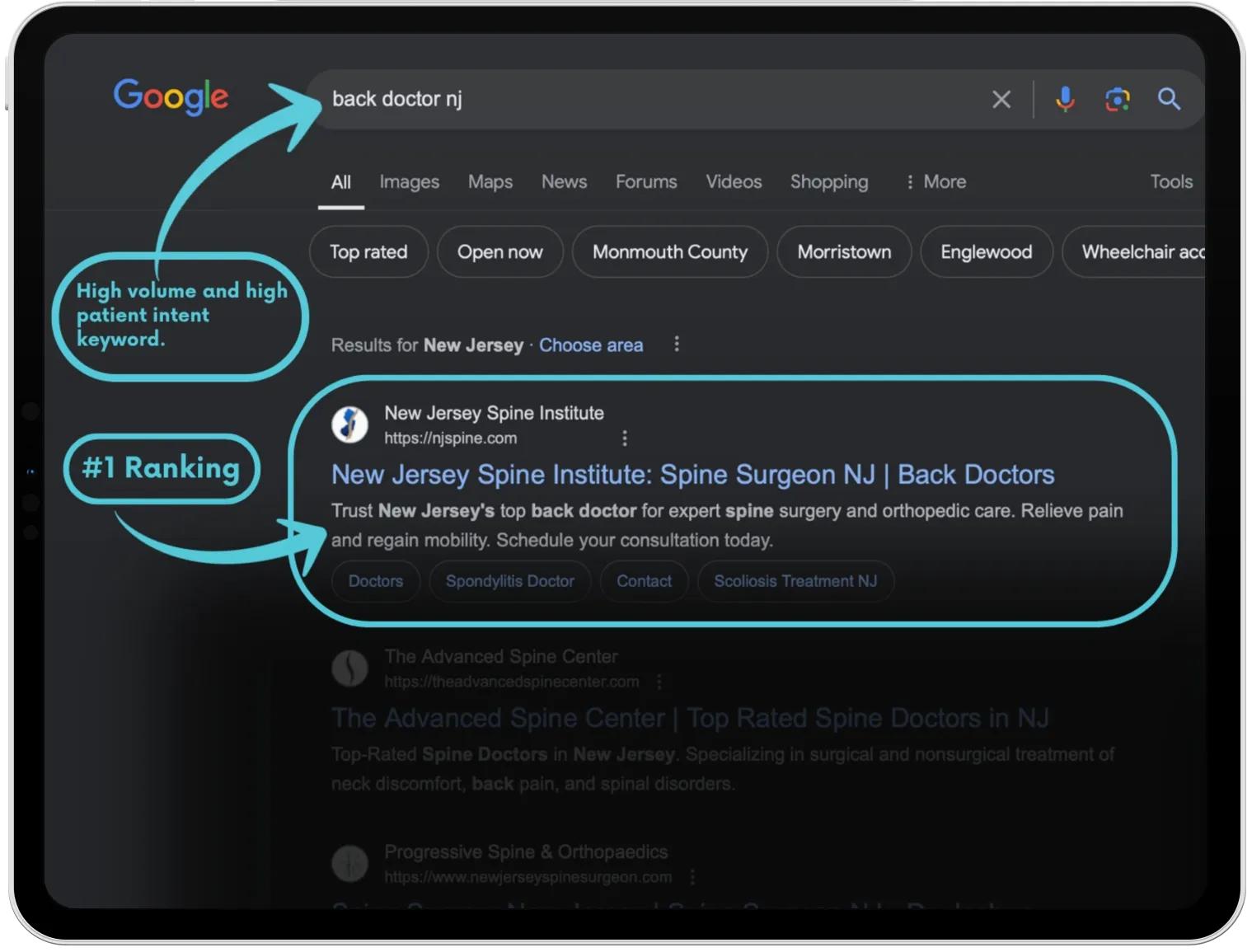
- #1On "Back Doctor NJ" & Equivalent High-Intent Terms
A $6K/month program measured against surgical bookings.
For the spine practice, every Google Ads dollar was tracked all the way through to attended consults and surgical bookings. The averages below are over a six-month window. Note: doubling marketing investment typically does not double results — it compounds them, often producing 2.5× the surgical case volume thanks to expanded reach and higher patient engagement.
- 01
Top-of-Funnel Performance
Spend, traffic, and engagement against a $6K/month budget on competitive spine keywords.
- Monthly ad spend: $6,000.
- Average cost-per-click (CPC): $6 on competitive spine keywords.
- Acquired clicks: 833 per month.
- Click-through rate (CTR): 7%.
- 02
Conversion Performance
Clicks turning into attended consults and booked surgical procedures.
- Conversion rate achieved: ~10% (six-month average).
- Attended appointments: 125 per month.
- Surgical bookings: 27 per month (~19% of attended consults).
- Engaged with 830+ active spine-care searchers monthly.
- 03
Surgical Economics
The numbers that actually matter for a surgical practice budgeting against marketing spend.
- Cost per surgical booking: $222.
- Return on ad spend: 2,602%.
- Cost-per-attended-consult held against verifiable patient revenue.
- Budget can scale 2× and typically delivers ~2.5× surgical case volume due to compounding reach.
Direct challenge resolution.
- ✕
Previous Challenges
Where both practices stood before the engagement.
- Critical specialty keywords unindexed or stuck on page 5-6.
- Generic positioning indistinguishable from regional competitors.
- No attribution from ad spend to attended surgical consults.
- Cost per new surgical booking was unknown.
- ✓
Achieved Outcomes
After sustained patient-targeted SEO + Ads execution.
- 200+ top-3 organic rankings on the orthopedic group, 30+ top-rank on the spine practice.
- #1 position held on "Back Doctor NJ" and equivalent high-intent terms.
- $222 verifiable cost-per-surgical-booking on the spine practice Google Ads program.
- 2,602% return on every ad dollar — tracked to attended consults and bookings.
Lessons for any specialty medical practice.
Specialty SEO and high-intent Google Ads compound on each other. The principles below are why the numbers above are sustainable, not one-off peaks.
- 01
Patient-Targeted Beats Volume-Targeted
Ranking for 200+ random keywords is meaningless. Ranking for 200+ keywords that actually produce surgical consults is the entire game. Patient-targeted keyword strategy is the difference.
- 02
Positioning Multiplies Rankings
Even a #1 ranked page underperforms if the positioning is generic. Every ranking gain is multiplied by sharper, more honest, more specialty-specific positioning — and depressed by undifferentiated copy.
- 03
Measure Ads Against Bookings, Not Clicks
Google Ads optimizes against the conversion it can see. If that conversion is a contact-form fill, the platform happily generates more contact-form fills regardless of whether they ever attend a consult. Measure against attended appointments and surgical bookings — and the platform will start filling those instead.
- 04
Budget Compounds, Not Just Adds
Doubling the ad budget typically does not double the results — it compounds them. More exposure builds brand recognition that lifts every other channel, often producing 2.5× the surgical case volume from a 2× spend increase.
What drove these results
Patient-Targeted SEO Strategy · Specialty Keyword Research · Website Development · Practice Positioning & Differentiation · Google Ads for Medical Practices · Call Tracking & Form Attribution · Cost-Per-Surgical-Booking Reporting.
Each program was tuned to the specialty — orthopedic upper extremity for the first client, spine for the second. Specialty-aware execution is what produced specialty-appropriate results.
Medical marketing, answered honestly.
How long until specialty medical SEO produces booked surgical consults?
Organic rankings typically start moving in months 2-3. The biggest ranking and traffic inflection arrives between months 6-12 as content, positioning, and authority signals all compound. Google Ads programs can produce booked consults within weeks of launch — provided attribution is wired correctly from the start.
How does cost-per-surgical-booking compare to cost-per-lead?
They are not comparable. Cost-per-lead measures contact-form fills — many of which never attend a consult. Cost-per-surgical-booking measures the patients who actually arrive, get evaluated, and get scheduled for a procedure. It is the only metric that maps directly to practice revenue. Every Hexapoint medical engagement is governed by it.
Can you really get an ROAS in the thousands of percent?
Yes, when the math works. A $222 cost-per-surgical-booking against an average surgical revenue per booking of several thousand dollars produces a return-on-ad-spend in the thousands of percent. The number above is real, measured against attended consults and verified surgical bookings, and held over a six-month window.
Do you work with specialty practices outside orthopedic and spine?
Yes. The patient-targeted SEO + positioning + measurable-Ads framework applies across orthopedic, spine, dermatology, plastic surgery, oral & maxillofacial, ENT, OB-GYN, and other specialty programs. The specifics change by specialty — the structure does not.
What does doubling our budget actually get us?
Typically more than 2× the results. Higher ad spend buys broader reach, which builds practice awareness that compounds every other channel. In our experience a 2× spend increase frequently produces 2.5× surgical case volume — because the additional exposure lifts both ad-driven and organic conversion rates simultaneously.
Spending on marketing without verified ROI?
Book a strategy call. We will show you what your real cost-per-attended-appointment looks like, what your cost-per-surgical-booking should look like, and how to bring them both into a verifiable range.